Program Info
| Program Title | Online Master of Science in Crime Analysis |
Course Info
| Course Title | Social Network Analysis |
| Course Number | CRJ 507 |
| Course Level | Graduate |
| Course Start-End | January 12th - March 3rd, 2026 |
| Class Meeting Times | Asynchronous |
| Class Location | Online |
Course Instructors
| Jacob T.N. Young | Associate Professor |
Office Hours
| Jacob T.N. Young | SCHEDULE |
Textbooks
| Social Network Analysis for Crime Analysts | Jacob T.N. Young | Required (but free!) | |
| Social Network Analysis for Crime Analysts Using R | Jacob T.N. Young | Required (but also free!) |
I. Course Description, Goal, & Learning Objectives
A. Overview
The objective of this course is to introduce students to Social Network Analysis and its practical application in the criminal justice system. Students will be able to understand and discuss the fundamental issues associated with social network analysis and will understand how to use software to conduct social network analysis. This course offers a practical, tools-based approach that is designed to build strong foundations for people who want to work as analysts in criminal justice fields. The course is analytically rigorous, but no prior programming experience is assumed. By the end, you will know how to construct networks, analyze them, and create reports on networks.
B. Course Objectives
The four main learning objectives for the course are:
- Identify the major theoretical ideas embodied by network science
- Collect your own social network data
- Analyze and interpret social network data
- Build reports on networks using RStudio and RMarkdown
C. Course Prerequisites:
There are no prerequisites, and I do not assume any prior background in network analysis, computer programming, or statistics. Students should, however, have installed R and RStudio, and worked through a basic tutorial on RStudio. Links to these resources are all provided in the course content.
II. Assessment of Student Performance & Proficiency
A. Performance Assessment
Assessment of student performance in this course is based on indications that the course learning objectives stated above have been achieved. Several areas of measurement will be used to produce a final student performance rating.
B. Demonstrating Proficiency
Students will demonstrate competency in understanding, producing, and communicating the results of their analyses through the following assignments:
- Weekly labs that provide opportunities to consolidate and apply material from the readings and tutorials
- Discussion topics on social network concepts as they pertain to crime and criminal justice
- A final project that integrates several skills developed through the course
Assigned work, including the final course project, as well as regular, active participation in online discussion sessions (a critical part of the course learning strategy) are the tools the instructor will use to measure comprehension and skill. The course grade is a direct reflection of demonstrated performance. Students should take stated expectations seriously regarding preparation, conduct, and academic honesty in order to receive a grade reflecting outstanding performance.
Note: Students should be aware that merely completing assigned work in no way guarantees an outstanding grade in the course. To receive an outstanding course grade (using the grading scheme described below and the performance assessment approach noted above), all assigned work should be completed on time with careful attention to assignment details.
III. Course Structure, Operations, & Expectations
A. Format & Pedagogical Theory
Incremental Progression
Mastering the concepts of social network analysis, as well as the data programming skills needed to conduct network analysis, is like learning a language. You start by mastering basic vocabulary that is specific to the field. Through your coursework, you will become conversant in how network scholars and analysts talk about networks as well as approaches to the analysis of networks. Progress might be slow at first as you work to master core concepts, integrate the building blocks into a coherent mental model of real-world problems, learn to translate technical results into clear narratives for non-technical audiences, and become comfortable with data programming skills. This is just part of the process. It sort of feels like this:
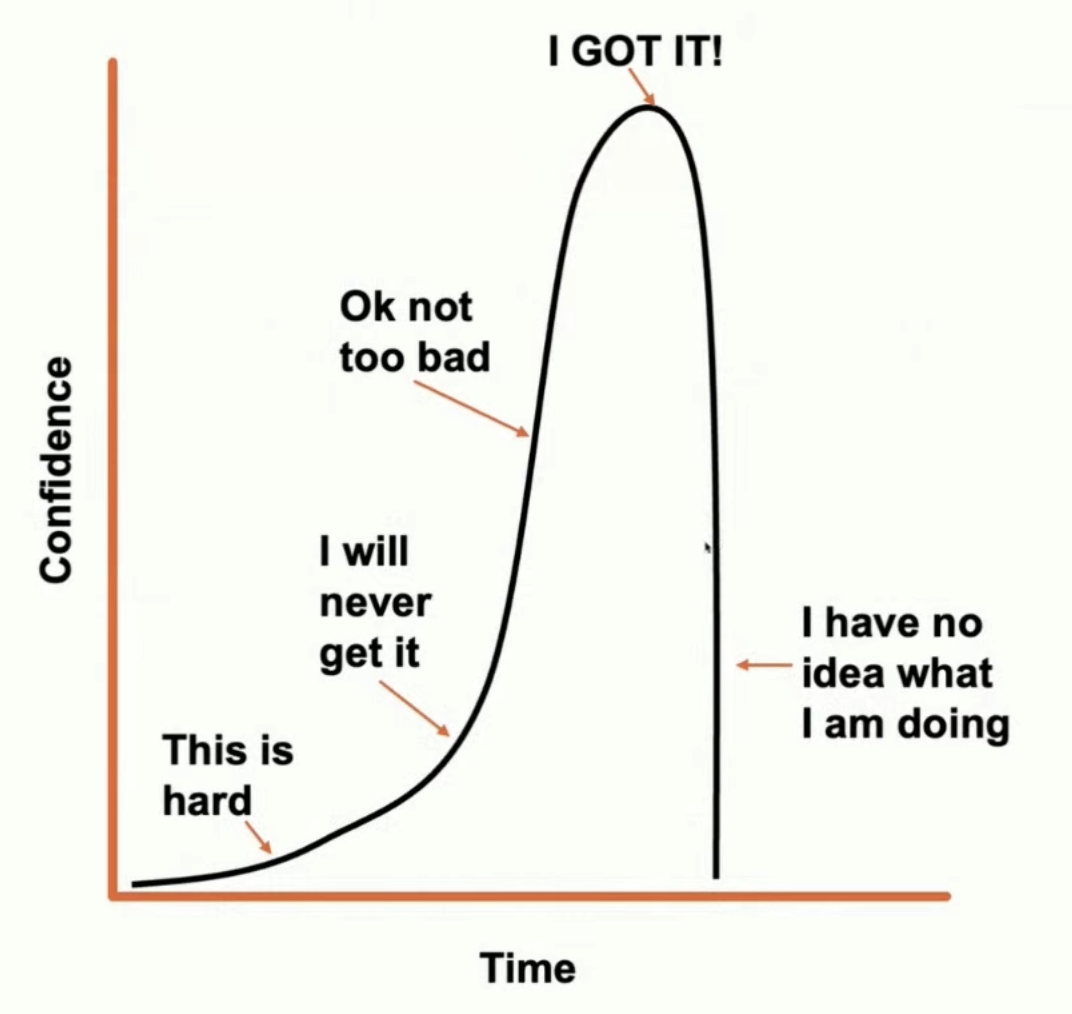
But, over time, you will find that your thought processes change as you approach network-related problems differently. In fact, you might come to see a whole new set of problems as answerable through network analysis. In other words, you begin to think and speak like a social network analyst.
Retention
Similar to immersion in a language, the best way to learn the material is to be consistent in doing coursework each day. The more frequently you revisit concepts and practice using the software, the more you will absorb. The curriculum has been designed around this approach. Readings and tutorials are split into small units, and each unit includes questions to test your understanding of the material. Weekly labs allow you to spend time applying the material to a specific problem. The final project at the end of the semester is designed to help you make connections between concepts and consolidate knowledge.
You will be much better off spending a small amount of time each day on the material instead of trying to cram everything into a couple of days a week.
Discussion
Online discussion boards are designed for students to engage with the material together. The purpose of online discussion sessions is threefold: (1) the online discussion sessions allow students to interact with their peers and share ideas and interpretations of the assigned material, (2) such peer-to-peer discussion online helps build professional relationships with potential future colleagues in the field, and (3) the discussions permit the instructor to assess student engagement with the assigned material.
The online discussions are explicitly intended to meet the objectives stated above. They are not intended as another form of readings or tutorial where the instructor provides commentary, and students simply react. Rather, the discussions are a chance for peer-to-peer interaction and proactive engagement by each individual student.
B. Assigned Reading Materials
We will use two custom textbooks for this course. First, Social Network Analysis for Crime Analysts was designed specifically for crime analysts seeking to learn the mechanics of social network analysis. Second, Social Network Analysis for Crime Analysts using R is a companion textbook that provides tutorials for conducting social network analysis in R. In addition to the required reading, the instructor will supplement these with journal articles.
C. Course Grading System for Assigned Work & Final Projects
This course does not use a +/- grading system. Rather, final letter grades will be awarded as defined in the table below:
| A | 90.00% – 100.00% | 90-100 |
| B | 80.00% – 89.99% | 80-89 |
| C | 70.00% – 79.99% | 70-79 |
| D | 60.00% – 69.99% | 60-69 |
| E | Below 60% | 59 and below |
The assigned work for the term comes in the form of three elements, described below.
Weekly Labs (60%)
Each week, you will receive a short lab that will help you synthesize the material from the week. Weekly labs will receive one of the following scores: 10 (excellent work!), 7 (great start, but there are a few things to fix), 3 (I can see you are working hard, but there are a number of areas that need fixing). Scoring is based on the answers you provide, the cleanliness of the code and output, and proofreading of the entire document.
On the day before the lab is due, I will grade the labs and provide feedback, noting any changes you might consider to improve your grade (if needed). This means that if you want to get feedback, turn it in early! NOTE: Weekly labs can be resubmitted once. You can make revisions to your lab, based on my feedback, and I will regrade it (once). For example, if you turn in a lab, receive a score of 7, and then revise the lab based on my feedback, you could earn a 10. Re-submissions with revisions will be accepted up to the day that the lab is due. Lab submissions or re-submissions will not be accepted after the lab review video is distributed, as it will provide the solutions to the lab.
Lab Review Video
After the due date for each lab, I will distribute a video with the solutions for the lab. In these videos, I will walk through the assignment and provide any additional insights that I deem necessary based on the grading of the labs.
Discussion Topics (10%)
YellowDig discussion topics are used to introduce you to the broad area of social network analysis. The weekly discussion topics are a chance to explore some resources or reflect on a specific theme or article. We will use YellowDig discussion boards for this assignment. You earn points through your activities on the board. You need to earn at least 100 points by posting topics and interacting with peers in order to earn full credit. The points are allocated as follows:
- New Pins: Creating a new pin with at least 50 words (5 pts)
- Comments Received: Receiving a comment on your pin (2 pts)
- Comments Made: Creating a comment on another pin (2 pts)
- Likes: Liking another pin (1 pt)
These points automatically update on Canvas. The total grade is cumulative, reflecting points contributing to 100%. A maximum of 20 points can be earned in each week’s discussions.
Final Project (30%)
This course will close with a final project. The final project will use all of the information you have learned in this course to create a report on a network. For the final project, you will use co-arrest data reported in Phoenix from the Phoenix Open Data Portal. These data represent incidents where individuals were arrested together. You will be asked to imagine that you work for a police department and your supervisor has asked you to create a report on co-offending networks.
The following criteria, description, and corresponding points are used to evaluate the project (30 points total):
- Answering Prompts: Providing responses for each of the prompts and code for all prompts (15 pts)
- Following Report Format Instructions: Following instructions for report content (i.e., not having extraneous code or output in the report) (10 pts)
- Proofreading and Style: Responses are free of grammatical errors; content exceeds expectations in functionality, design, layout, analysis, or insights (5 pts)
D. General Grading Rubric for Written Work
In general, any submitted work is assessed on these evaluative criteria:
- Completeness: All elements of the assignment are addressed
- Quality of Analysis: Substantively rigorous in addressing the assignment
- Understanding: Demonstrated synthesis and application of core lecture concepts
- Appearance: Consistent formatting, style, spelling, grammar, and conventions in code/text
E. Late and Missing Assignments
Grades for the course are largely based on weekly labs. Assigned work is accompanied by detailed instructions, adequate time for completion, and opportunities to consult with me to ask questions. As a result, each assignment element in the course is expected to be completed in a timely fashion by the due date. After each lab is due, I will record and post a lab review video. After the video is distributed, it is no longer possible to receive points for assignments.
F. Course Communications and Instructor Feedback
Course content is hosted on this website. Lecture files, assignments, and other course communications will be transmitted via this site and/or through the class email list. All assignment submissions will be made through Canvas.
Please post lab questions on the Get Help page on this site, schedule individual office hours using the Calendly link, and email me. Please do not use the Canvas system to send emails or course questions, as it is not set up well for handling questions that we will address in this course.
Be aware that I will attempt to respond to any course-related email as quickly as possible. I ask that you allow between 24 and 48 hours as a reasonable time to reply to questions or other issues posed in an email. Additionally, the general timeline for grading and feedback on assignments is no more than 3 work days.
ASU email is the official means of communication among students, faculty, and staff. You bear the responsibility for missed messages and should check your ASU-assigned email regularly. All correspondence will be sent to your ASU email account. Please ensure Canvas notifications are being sent to your email.
G. Student Conduct: Expectation of Professional Behavior
Respectful conversations and tolerance of others' opinions will be strictly enforced. Any inappropriate language, threatening, harassing, or otherwise inappropriate behavior during discussion could result in the student(s) being administratively dropped from the course with no refund, per ASU Policy USI 201-10.
Students are required to adhere to the behavior standards listed in the Arizona Board of Regents Policy Manual Chapter V: Campus and Student Affairs.
H. Academic Integrity and Honesty
ASU expects the highest standards of academic integrity. Violations of academic integrity include, but are not limited to, cheating, plagiarism, fabrication, etc., or facilitating any of these activities.
Plagiarism will not be tolerated. Any student who plagiarizes or fabricates her or his work will receive no credit for the assignment. Additional disciplinary action following investigation may occur at the discretion of the instructor, up to and including course failure.
For more information, refer to the Office of the Provost’s Guide to Academic Integrity.
I. Student Learning Environment: Accommodations
Disability Accommodations: Students should be aware that Arizona State University is committed to providing reasonable accommodation and access to programs and services to persons with disabilities. Students with disabilities who wish to seek academic accommodations must contact the ASU Disability Resources Center directly. Information on the Center's procedures, resources, and how to contact its staff can be found at the Disability Resource Center. The Disability Resources Center is responsible for reviewing any student's requests; once that review has taken place, the Center will provide the student with appropriate information on academic accommodations, which in turn will be provided to the course instructor.
Religious accommodations: Students will not be penalized for missing an assignment due solely to a religious holiday or observance, but as this class operates with a fairly flexible schedule, all efforts should be made to complete work within the required timeframe. If this is not possible, students must notify the instructor as far in advance as possible in order to make an alternative arrangement.
Military Accommodations: A student who is a member of the National Guard, Reserve, or other branch of the armed forces and is unable to complete classes because of military activation may request complete or partial unrestricted administrative withdrawals or incomplete, depending on the timing of the activation. For more information, see ASU Policy USI 201-18.
IV. AI Policy
Use of generative AI tools (e.g., ChatGPT, Copilot, Gemini, Claude, Code Llama, etc.) is strictly prohibited in this course. This includes, but is not limited to, using AI tools to:
- Write or edit code
- Debug code
- Generate explanations, summaries, or interpretations
- Complete any portion of assignments, quizzes, or projects
- Transform, rewrite, or analyze course materials or templates
You are expected to complete all work independently using only the materials and code provided in the course. All code needed to complete assignments is provided within the course materials. Therefore, any code or approach not found in the course materials will be assumed to have originated from a generative AI tool.
If your submission contains material outside the scope of the course-provided resources, it will be treated as a violation of this policy. If an assignment contains AI-generated content or unauthorized code, the assignment will receive a 0 and you will be required to redo the assignment using only approved course materials.
Note that all course templates used for the labs are copyrighted instructional materials. It is a violation of course policy and copyright law to upload or paste any portion of these materials into a generative AI system or external tool for processing, rewriting, or analysis. You may use the templates only for completing your coursework in this class. Redistribution, uploading, or repurposing of these materials is strictly prohibited.
Why this policy? This course is about learning the materials I have provided. Using generative AI bypasses these learning objectives and prevents meaningful assessment of your work.
V. Course Schedule
A. Schedule: Overview of Readings and Assignments
ASU Online courses are typically offered on a seven and a half week schedule. A schedule for each week of the term is outlined in the Course Schedule. The course is divided into seven units with specific learning objectives for each unit.
Note: I may, from time to time, adjust assigned readings or adjust the due dates for assignments. The basic course content approach and learning objectives will not change, but slight modifications are possible if circumstances warrant an adjustment.
Visit the Course Schedule.